


Tips
Fulfilment for small online stores: when it pays off and when to keep packing yourself
A single-item order through a fulfilment provider costs about €3.80 to €5.50 all in, and the price per order barely falls with volume. How to price your own packing, when outsourcing pays off, and what to ask before you sign.

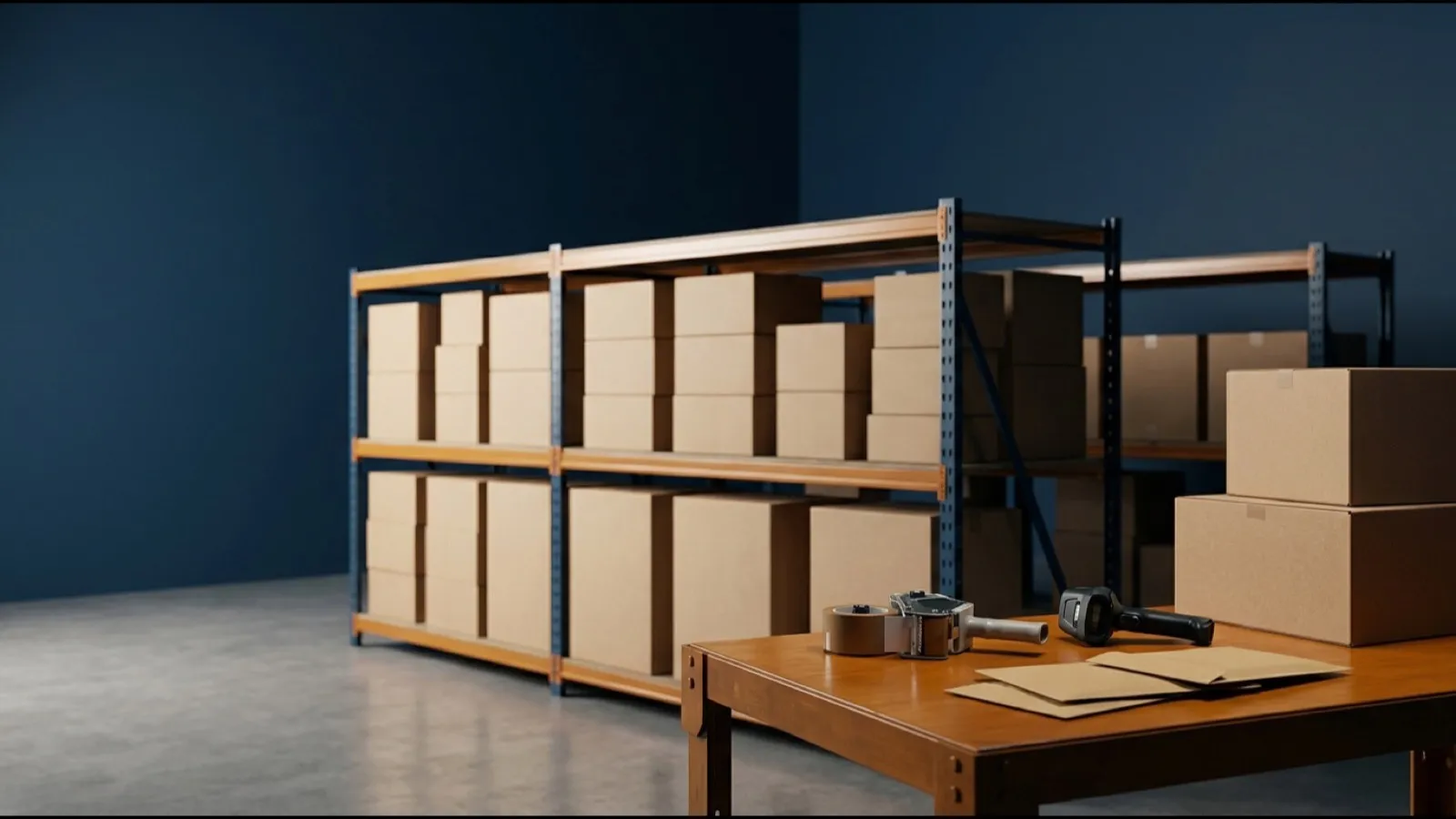
A spare room full of boxes, evenings spent at the label printer and a weekend away cancelled because thirty orders have to leave on Monday. Most small online stores start out exactly like this. Sooner or later the question comes up: should someone else be doing the packing?
Fulfilment is the obvious answer. The catch is that at low volumes it usually saves time, not money, and that difference is worth working out before you sign anything.
What you actually pay for
A fulfilment provider takes over the whole chain from receiving stock to handing the parcel to the carrier. The price is never a single line item. Published 2026 price lists from Central European providers look roughly like this:
| Item | Typical price (excl. VAT) |
|---|---|
| Order processing, 1 item | €0.80–€1.50 |
| Each additional item | €0.20–€0.50 |
| Standard packaging | €0.40–€1.20 |
| Pallet storage | €15–€35 per month |
| Shelf storage | €3–€10 per month |
| Domestic courier delivery | €2.20–€3.50 |
| Returns processing | €0.80–€2.00 per item |
Under a euro to pack an order sounds almost suspiciously cheap. It is: that is the entry price for the simplest possible case, one item in one box with nothing special. Add storage, packaging, returns and delivery, and a typical single-item order lands at €3.80 to €5.50.
What a small store really spends
Worked examples published by the Slovak provider Pack4you in March 2026 put a start-up store with 120 orders a month at €530 to €700 a month, or about €4.40 to €5.80 per order.
A growing store with 600 orders pays €2,700 to €3,500, and an established one with 1,500 orders €5,900 to €7,500. In other words, the cost per order barely moves: it only drops to around €3.90 to €5.00 at the top end. Volume discounts, where they exist, are negotiated across a table rather than read off a price list.
Remember that delivery sits inside those numbers. You would pay the courier anyway, so the figure to compare with your own operation is the handling part: processing, packaging and storage.
Price your own packing honestly
This is where most owners get it wrong. Packing in-house feels free because nobody invoices for it.
- Time. Picking, packing, printing a label and marking the order as shipped easily takes five to ten minutes, longer for a four-item order. At 120 orders and six minutes each, that is 12 hours a month. Value your hour at €15 (modest for someone running a business) and you are at €180, or €1.50 a parcel.
- Packaging and void fill. Boxes, bubble wrap, tape. Our packaging supplies guide covers where to buy them for less.
- Space. Even a spare room has a cost. You just don’t see it on a lease.
- Mistakes. A wrongly picked order means paying for delivery three times: out, back and out again. One of those wipes out the margin on a lot of parcels that went fine.
Pack4you’s own rule of thumb is that fulfilment pays for itself once in-house handling costs more than €1.50 to €2.00 per parcel, excluding shipping. Below that, outsourcing will not save you money. It may still make sense, you would just be buying something else. For a quick look at margins, try the e-commerce ROI calculator.
When fulfilment is worth it
Order volume alone does not decide it. Some providers take stores with no minimum volume, others talk about thousands of orders a month, so there is no universal threshold. These signals say more:
- Packing takes more than a day a week and that time is missing from buying, marketing or customer service.
- You have sharp seasonal peaks. Black Friday and Christmas, when you cannot keep up, while for the rest of the year you are looking at half-empty shelves. A warehouse can stretch its capacity; your garage cannot. Keep an eye on the shipping deadlines tool during peak season.
- You want same-day dispatch. That works at home right up until you are ill or on holiday.
- You have run out of room and the next step would be renting a warehouse. This is where fulfilment wins most clearly: you pay for the pallet spaces you use, not for a whole unit on a three-year lease.
When to keep packing yourself
Some stores are a poor fit for fulfilment even at higher volumes, and there is nothing wrong with that.
- Personalised or handmade goods. Engraving, gift notes, made-to-order bundles. A warehouse either will not do it or will charge properly for it.
- Packaging as part of the brand. Tissue paper, a handwritten card, a free sample. Possible with a provider, but every extra step is another surcharge.
- Fragile, oversized or hazardous goods. Price lists assume standard items; glass, furniture or batteries are usually quoted individually.
- A fast-changing range in small batches. Each inbound delivery is charged separately, so ten small deliveries a month add up.
Questions to ask before you sign
A published price list is only a starting point, and it almost always says it is indicative. Get written answers to these before you decide.
- Is there a minimum monthly fee? Some centres charge one. In January, when you sell next to nothing, you pay it all the same.
- What do integration and stock counts cost? Connecting your store and physical inventory audits are often billed separately.
- What is the cut-off time for same-day dispatch? It decides what delivery promise you can put in your checkout.
- Who is liable for stock discrepancies? A lost or damaged item needs a clear compensation process.
- Which carriers does the warehouse use, and can you keep your own contracts? For an overview of international options, see international couriers compared.
- How do you leave? Notice period and the cost of shipping out all your stock. Nobody thinks about it at the start, and it hurts when you switch providers.
Warehousing abroad and VAT
A fulfilment centre in Germany or Poland is tempting because it shortens delivery times for customers there. It feels like the natural next step. But stock held in another EU country changes your VAT position.
The One Stop Shop (OSS) covers distance sales, where a parcel travels from your home country to a consumer in another member state. A sale from stock that already sits in the customer’s country is a local supply there, and OSS does not cover it. In practice that usually means registering for VAT in the warehouse country and filing returns locally. Talk it through with a tax adviser, not the warehouse’s sales rep, before any stock crosses a border. For the import side of EU VAT, see the IOSS guide for online stores.
A middle step: automate before you outsource
If what really wears you down is labels and retyping addresses rather than the packing itself, you do not need to move your stock yet. Get rid of the manual work first. Multi-carrier platforms such as Sendcloud print labels for several carriers from one screen and pull orders straight from your store. The trade-offs are covered in Sendcloud vs Packlink vs direct carrier contracts and Eurosender vs Sendcloud.
You still pack the boxes, but the most tedious part disappears. Only when that is not enough is it time for a warehouse.
Before you call a fulfilment centre
- Compare handling, not delivery. If your in-house handling costs less than about €1.50 to €2.00 per parcel including your time, outsourcing will not save money.
- Fulfilment mainly buys time and flexibility. It makes most sense for seasonal peaks, lack of space and same-day dispatch.
- Read the contract, not the price list. Minimum fees, integration, stock counts and exit costs decide the real price far more than the headline per-order rate.
More for merchants is in the e-commerce section, and if you are deciding where to set a free shipping threshold, the free shipping calculator runs the numbers.
Quick facts
Fulfilment for small online stores: when it pays off and when to keep packing yourself
schedule Updated
Summary
Fulfilment means an external warehouse takes over storage, picking, packing and handing parcels to the carrier, and the online store pays only for the capacity it actually uses. Published 2026 price lists from Central European fulfilment providers put the all-in cost of one single-item order at roughly €3.80 to €5.50 excluding VAT, domestic delivery included. The main components are pallet storage at about €15 to €35 per month, order processing at €0.80 to €1.50, €0.20 to €0.50 for each extra item, standard packaging at €0.40 to €1.20 and domestic courier delivery at €2.20 to €3.50. Returns add €0.80 to €2.00 per item. Worked examples show the cost per order barely falls with volume: around €4.40 to €5.80 at 120 orders a month and €3.90 to €5.00 at 1,500. For a small store fulfilment usually saves time and seasonal capacity rather than money. Holding stock in another EU country changes the VAT picture: the One Stop Shop covers intra-EU distance sales, not local sales from a warehouse in the customer’s country, which typically require a VAT registration there.
- All-in cost per order
- €3.80–€5.50 excl. VAT, single item, domestic delivery included
- Order processing (1 item)
- €0.80–€1.50, plus €0.20–€0.50 per extra item
- Pallet storage
- €15–€35 per pallet per month
- Returns processing
- €0.80–€2.00 per item
- Break-even signal
- In-house handling above €1.50–€2.00 per parcel, excluding shipping
- Stock in another EU country
- Local sales from that stock fall outside OSS; VAT registration usually required